


 Raised
in the Chicago Church of Christ, graduated from a competitive high
school for gifted students at 16 and now a sophomore at a highly
demanding private college, how do you navigate through the maze of human
philosophy thrown your way? Tabbey Walquist shares her journey with a
great message for teens, parents and church leaders.
Raised
in the Chicago Church of Christ, graduated from a competitive high
school for gifted students at 16 and now a sophomore at a highly
demanding private college, how do you navigate through the maze of human
philosophy thrown your way? Tabbey Walquist shares her journey with a
great message for teens, parents and church leaders.
Postmodernism. Wikipedia describes it as "the belief that many, if
not all, apparent realities are only social constructs, as they are
subject to change inherent to time and place." In practice, it is the
rejection of the idea that humans can know real, unadulterated truth. We
see it in our culture frequently, in political correctness, delicate
treatment of personal beliefs, and the idea that what works for one
person might not work for the other. Postmodernism celebrates the power
of the self, taking Descartes' cogito ergo sum to a whole new level. It
allows each individual to have his own reality, and shies away from any
solid conclusions other than that there are no solid conclusions.
This was my favorite way of thinking. There were so many possibilities,
so many freedoms that came with having your own truth! You could have
your own power, and paint the world any way you pleased. No philosophies
or religions applied to me, because even if they had some level of
truth, they also had some level of falsehood. I reveled in rationalism,
and consumed the works of every philosopher I came across, looking for
pretty phrases and clever, logical arguments.
These ideas appealed to me far more than my parents' beliefs did. I grew
up in the church, surrounded by people whose actions I didn't
understand--and whom I grew to disparage, to no fault of their own. As I
got older, I ignored the Bible with increasing disdain, because it was
irrational. God was a human construct, like the Greeks' gods were,
created solely for easing people's fears and feelings--and basing
anything on feelings was only for the weak-minded and unstable.
 All
the philosophies I read were like puzzles. I loved being able to put a
man's work together, see where the pieces fit, then point out the gaping
holes. None of these ideas were applicable to my life, just fancy
intellectual exercises that allowed for interesting discourse and a
feeling that we were shaving away pieces of falsehood that didn't
belong, asymptotically approaching truth. It was clear we'd never find
truth, much less an applicable truth, but our conversations were
exhilarating in their futility.
All
the philosophies I read were like puzzles. I loved being able to put a
man's work together, see where the pieces fit, then point out the gaping
holes. None of these ideas were applicable to my life, just fancy
intellectual exercises that allowed for interesting discourse and a
feeling that we were shaving away pieces of falsehood that didn't
belong, asymptotically approaching truth. It was clear we'd never find
truth, much less an applicable truth, but our conversations were
exhilarating in their futility.
Indeed, the most pronounced characteristic of philosophers is their
failure to reconcile their ideas with real life. They leave you begging
for a level of practicality they can't possibly deliver. How can they
describe humans as rational beings, claim that anything that matters can
be figured out by man's intellect, then turn around and try to explain
the complexities and intricacies of the soul? They can't expect people
to live as though they don't believe in truth (or, at the very least,
natural law). It is truly both impractical and exhausting to live in
constant doubt and skepticism.
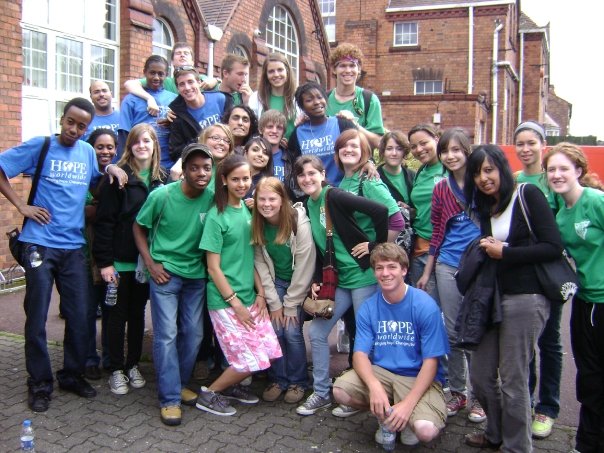 For
a long time, I thought it was impossible to have an airtight, practical
philosophy. Humans are flawed by nature, so, of course, our thinking
should be, too. Then, the summer after my senior year of high school, I
went on HOPE Youth Corps.
There, I met about twenty young adults who had dedicated their lives to
serving God and imitating Christ. This group was unlike any other I had
encountered before.
For
a long time, I thought it was impossible to have an airtight, practical
philosophy. Humans are flawed by nature, so, of course, our thinking
should be, too. Then, the summer after my senior year of high school, I
went on HOPE Youth Corps.
There, I met about twenty young adults who had dedicated their lives to
serving God and imitating Christ. This group was unlike any other I had
encountered before.
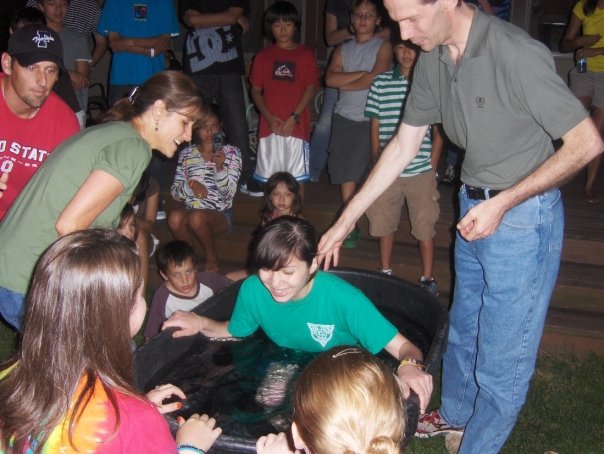
When we had only known each other a few hours, they were pouring
their hearts and lives out, openly loving their brothers and sisters in
Christ for that simple reason--they had Christ in common. Whatever
activities we had, they were completely dedicated, bringing Colossians
3:23 to life. They were among the most selfless people I had ever met,
laying down their lives for each other, for those we were serving, and,
of course, for Christ. I watched as the lessons we learned became more
than just fuel for good discussion, but something that was applicable in
their lives. Hearing their conversion stories, becoming their friend, I
was more intrigued by Christianity than I had ever been. Christianity
was no longer a construct, but a real, effective way of living. Although
I was still not completely convinced of its validity, I wondered what
would happen if I applied it to my life.
 So
I began to read my Bible on my own and pursue a relationship with
God--which was no small feat, considering I barely believed in his
existence. Though I didn't want to admit it, I thought it was plausible
that he could exist--I didn't think that the universe could come into
being without intelligent design--but I didn't think he was relevant,
nor did I "feel" his presence, as some Christians claimed they did.
So
I began to read my Bible on my own and pursue a relationship with
God--which was no small feat, considering I barely believed in his
existence. Though I didn't want to admit it, I thought it was plausible
that he could exist--I didn't think that the universe could come into
being without intelligent design--but I didn't think he was relevant,
nor did I "feel" his presence, as some Christians claimed they did.
Despite myself, as I learned to pray and apply what I read, I
witnessed an amazing change in my life. No longer was I an extremely
cynical, prideful, self-absorbed snot; I was now a somewhat cynical,
slightly less prideful, self-absorbed snot who had motivation and a
guide to become even less so. And I began to be acquainted with a
perfect being who loved me, would lay down his life for me in the most
atrocious way possible, despite my flaws, and by whose existence the
perfect way to live became available to all who would listen.
I don't think there was a point where I consciously decided that being a
postmodernist was unappealing. I knew the Bible was likely accurate
because of its historical descriptions and such, but I think I came to
really believe in its truth by its application. When I did what the
Bible said, God changed my life the way he promised, and it was
palpable. For me, this was more effective than the most highbrow of
philosophies. None of those other philosophies, though interesting,
could be guaranteed to be true; but despite its more intangible,
outrageous claims, this one could be verified by visible things that had
and would come true.
As I continue to pursue God and his divine word, I become increasingly
persuaded. His elegance and soundness are breathtaking to behold,
especially because he does what no human philosopher could. Christianity
is the most perfectly rational philosophy--it never contradicts itself,
it doesn't have holes, and it incorporates the real world. It works
both in practice and in theory. By the grace of God, it has the power to
change lives for the better, and it professes that there is an actual
truth--and it is possible to know it. God doesn't promise us an
exhaustive knowledge of his inner workings, but through Christianity he
promises true knowledge that is applicable in every aspect of life.
Where is the wise man? Where is the scholar? Where is the philosopher
of this age? Has not God made foolish the wisdom of the world?...For
the foolishness of God is wiser than man's wisdom, and the weakness of
God is stronger than man's strength. - 1 Corinthians 1:20, 25
Tabbey Walquist
Macalester College, 2013
Illinois Math and Science Academy, 2009
send Tabbey a message at: This email address is being protected from spambots. You need JavaScript enabled to view it.
Click here for more info on HOPE Youth Corps
Click here for campus internship opportunities
You may also be interested in this article: Confessions of a Kingdom Kid at Harvard